As the global adoption of photovoltaic (PV) systems continues to accelerate, maintaining excellent power quality has become just as important as generating clean energy. While solar power offers significant environmental and economic benefits, integrating large-scale PV systems into modern electrical grids also introduces new technical challenges—particularly harmonic distortion, voltage fluctuations, and reactive power issues.
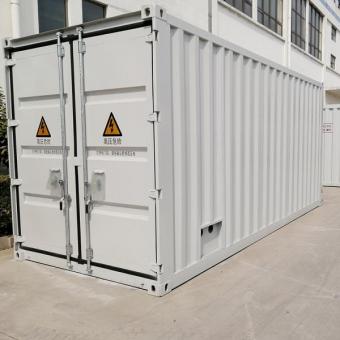
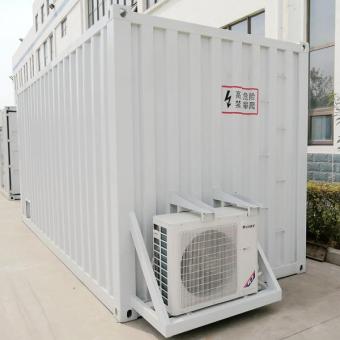
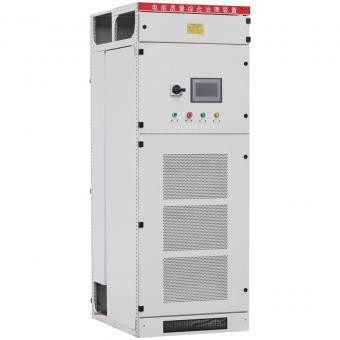
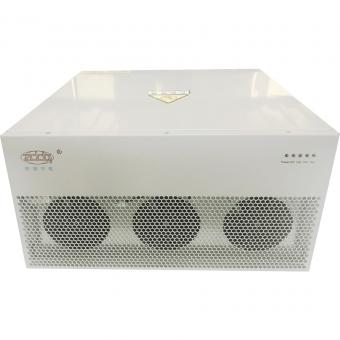
One of the most effective solutions is the Active Power Filter (APF). By combining PV generation with advanced harmonic filtering technology, businesses can improve grid stability, protect electrical equipment, and maximize the performance of their renewable energy investments.
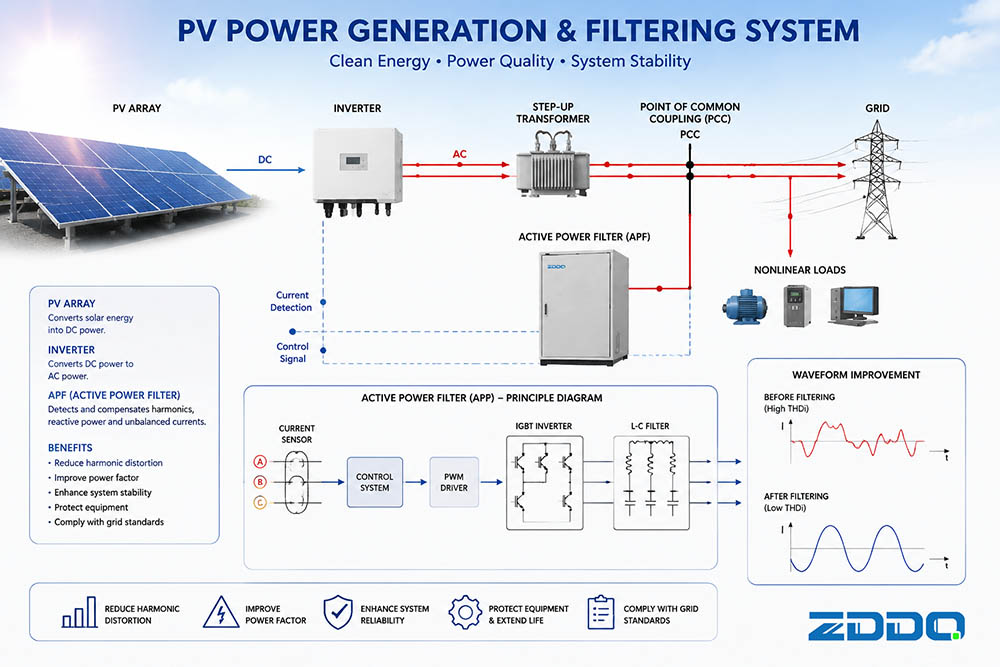
A typical grid-connected PV system consists of several major components:
PV Array: Converts sunlight into DC electricity.
Inverter: Converts DC power into AC power suitable for the utility grid.
Step-up Transformer: Raises voltage to the required distribution level.
Point of Common Coupling (PCC): The connection point between the PV system and the electrical grid.
Grid and Loads: Supply electricity to industrial, commercial, or residential consumers.
While modern inverters are highly efficient, they are power electronic devices that can generate harmonic currents. In facilities with numerous nonlinear loads such as variable frequency drives (VFDs), UPS systems, welding equipment, and data centers, harmonic distortion can become even more severe.
Harmonics are unwanted electrical frequencies that distort the ideal sinusoidal waveform. Excessive harmonic distortion may lead to:
Overheating of transformers and cables
Reduced efficiency of electrical equipment
Nuisance tripping of protective devices
Lower power factor
Increased maintenance costs
Reduced equipment lifespan
Difficulty complying with IEEE 519 and other grid standards
As PV penetration increases, maintaining low Total Harmonic Distortion (THD) becomes essential for both system reliability and regulatory compliance.
An Active Power Filter continuously monitors the electrical system and detects harmonic currents in real time. Using advanced digital control algorithms, it generates compensation currents that are equal in magnitude but opposite in phase to the unwanted harmonics.
The compensation process typically follows these steps:
Current sensors measure load current.
The controller calculates harmonic components.
PWM technology controls an IGBT inverter.
The inverter injects compensating current through an LC filter.
Harmonic currents are canceled before entering the utility grid.
The result is a much cleaner current waveform with significantly reduced THD.
Adding an APF to a PV installation delivers several important advantages:
The APF effectively suppresses harmonic distortion and restores a near-sinusoidal current waveform, helping maintain stable system operation.
Reactive power compensation improves the overall power factor, reducing utility penalties and increasing energy efficiency.
Sensitive equipment—including inverters, transformers, motors, and control systems—operates more reliably under cleaner electrical conditions, extending service life.
Many utilities require distributed energy resources to satisfy harmonic limits. APFs help ensure compliance with standards such as IEEE 519.
Stable voltage and reduced harmonic interference improve the long-term reliability of both the PV plant and connected industrial loads.
The combination of solar PV generation and active harmonic filtering is widely used in:
Solar farms
Industrial manufacturing facilities
Commercial buildings
Data centers
Hospitals
Electric vehicle charging stations
Smart factories
Renewable energy microgrids
These applications often include large numbers of nonlinear loads, making harmonic mitigation a critical part of system design.
As renewable energy becomes a larger part of the global energy mix, power quality will remain a key factor in achieving reliable and efficient grid operation. Integrating Active Power Filters with photovoltaic systems is no longer just an optional upgrade—it is becoming an essential component of modern power infrastructure.
By reducing harmonic distortion, improving power factor, protecting valuable electrical assets, and ensuring grid compliance, APFs help solar energy systems operate at their highest potential while supporting a cleaner and more resilient electrical network.
Categories
new blog


NO.25,JINHE RD,HUAIYUAN ECONOMIC DEVELOPMENT ZONE ,BENGBU,ANHUI
Scan to WhatsApp: