With the rapid development of battery energy storage systems (BESS), many people ask whether the reactive power compensation function of a PCS can replace a dedicated SVG.
The answer is: Sometimes yes, but not always.
PCS (Power Conversion System) is mainly used to convert electrical energy between the battery and the grid.
In addition to active power control, many PCS units can also provide reactive power compensation. This helps improve power factor and support grid voltage.
However, PCS has a limitation: its active power and reactive power share the same converter capacity.
For example, when a PCS is fully loaded with active power, its remaining reactive power capability may be limited.
Therefore, the PCS may need to reduce active power output if more reactive power is required.
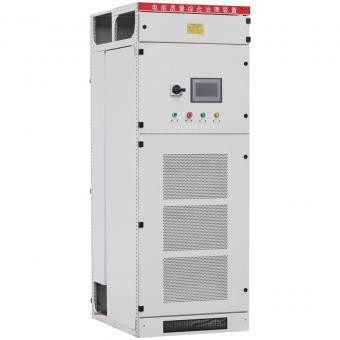
SVG (Static Var Generator) is designed specifically for dynamic reactive power compensation.
It can provide capacitive or inductive reactive power independently of battery charging and discharging.
SVG is especially useful for:
Industrial loads with rapidly changing reactive power.
Power factor correction.
Grid voltage support.
Reactive power compensation when the battery is idle.
Projects requiring additional reactive power capacity.
Unlike PCS, SVG does not need to reserve its main capacity for battery energy conversion.
|
PCS |
SVG |
|
Mainly converts battery energy |
Mainly compensates reactive power |
|
Reactive power is an additional function |
Reactive power is the main function |
|
Active and reactive power share capacity |
Dedicated reactive compensation capacity |
|
Suitable for integrated BESS applications |
Suitable for independent dynamic compensation |
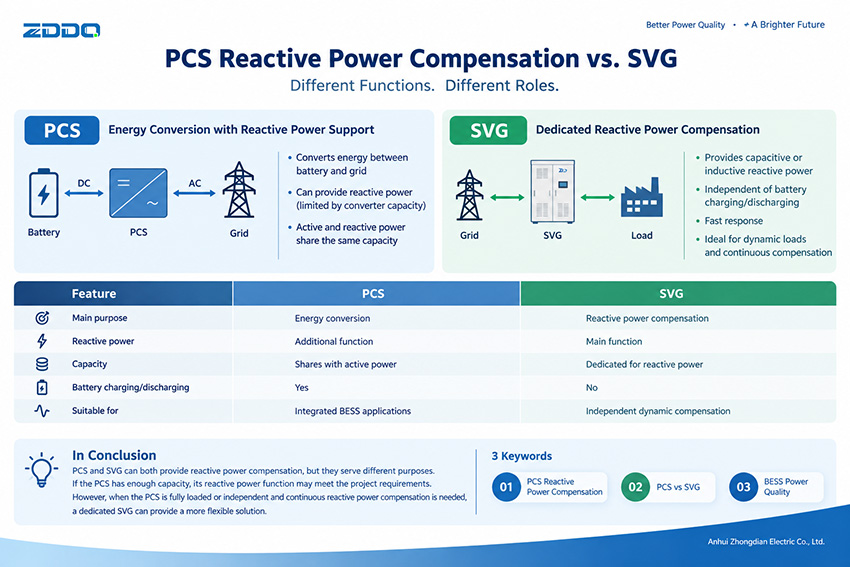
PCS and SVG can both provide reactive power compensation, but they serve different purposes.
PCS is primarily an energy conversion device with reactive power capability, while SVG is a dedicated reactive power compensation device.
If the PCS has sufficient capacity, its reactive power function may meet the project requirements.
However, when the PCS is fully loaded, or when independent and continuous reactive power compensation is needed, a dedicated SVG can provide a more flexible solution.
For modern energy storage and renewable energy projects, the best choice depends on the actual power demand, system capacity, and grid requirements.
Anhui Zhongdian Electric Co., Ltd. provides power quality solutions for different industrial and energy applications, helping customers select suitable reactive power compensation equipment for their projects.
Categories


NO.25,JINHE RD,HUAIYUAN ECONOMIC DEVELOPMENT ZONE ,BENGBU,ANHUI
Scan to WhatsApp: