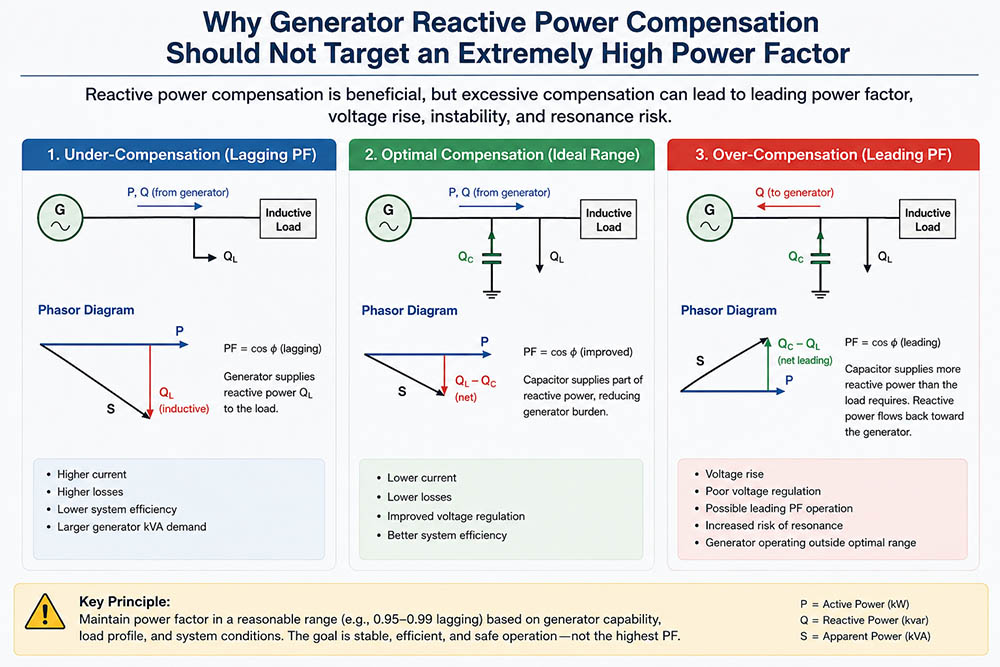
At first glance, a power factor close to 1.00 seems ideal. But for a generator, excessive reactive power compensation can create operating conditions that are less stable and potentially harmful to the generator itself. The goal should therefore be optimized power factor correction, not simply the highest possible power factor.
When a load is supplied by a utility grid, the grid is usually very large compared with the individual load. Its voltage and frequency are relatively stiff, so moderate changes in reactive power have limited influence on the overall system.
A generator is different.
A generator has limited capacity and its voltage is closely related to its excitation system and reactive power output. If a capacitor bank is connected to compensate inductive loads, the generator's reactive power demand decreases.
This sounds positive—and it usually is.
The problem begins when compensation continues beyond the actual reactive demand of the loads.
Once the system becomes overcompensated, the generator may no longer be supplying reactive power to the load. Instead, reactive power can begin to flow from the capacitor bank toward the generator.
In other words, the generator can be forced into a leading power-factor operating condition.
For a conventional inductive load, the generator normally supplies both active power and a certain amount of reactive power.
A simplified relationship is:
S² = P² + Q²
where:
P = active power
Q = reactive power
S = apparent power
Compensation reduces Q and therefore reduces the generator's apparent power burden.
But if Q is reduced too far and becomes negative, the generator enters a leading reactive power condition.
This is an important distinction: reducing reactive power is beneficial only while the compensation remains within an appropriate operating range.
A power factor of 0.95 or 0.98 may be technically more practical than trying to force the system to remain at exactly 1.00 under every load condition.
One of the major concerns with excessive compensation is voltage rise.
Capacitor banks generate reactive power. When the generator is lightly loaded and a large amount of capacitance remains connected, the capacitive reactive power may become significant compared with the generator's actual load.
Because a generator is not an infinite bus, this reactive power can have a noticeable influence on terminal voltage.
The result may include:
Increased generator terminal voltage
Voltage fluctuations during load changes
More difficult voltage regulation
Increased stress on insulation and electrical components
Unstable operation of sensitive loads
This is particularly important for systems where generator loading changes frequently.
A capacitor bank that is perfectly suitable when the generator is heavily loaded may become excessive when the load suddenly drops.
Synchronous generators have specific operating limits for reactive power.
When operating with a leading power factor, the generator enters a different region of its capability curve. Excessive leading reactive power can affect the excitation system and generator stability.
In practical applications, the generator manufacturer normally specifies an allowable operating range for reactive power.
Therefore, compensation should not be designed solely around a target such as:
“The closer to 1.00, the better.”
Instead, engineers should consider the generator's P-Q capability curve, excitation characteristics, minimum load, and dynamic load profile.
This is especially important for standby generators, where the actual load can vary significantly over time.
Capacitors do not simply “remove” reactive power. They also change the electrical characteristics of the system.
Generators have subtransient, transient, and synchronous reactances, while capacitor banks introduce capacitive reactance. Together, these elements can create resonance conditions.
If nonlinear loads such as:
Variable frequency drives
UPS systems
Rectifiers
Switching power supplies
Data-center equipment
are connected to the same generator system, harmonic currents may interact with the capacitor bank.
This can result in:
Harmonic amplification
Capacitor overheating
Voltage distortion
Protection trips
Reduced capacitor lifetime
Therefore, simply increasing capacitance until the power factor reaches an extremely high value is not a complete power-quality strategy.
Imagine a generator supplying a factory.
During peak production, the factory consumes substantial inductive reactive power. A capacitor bank can effectively compensate this demand.
But during the night, many motors and production machines are switched off.
The active load decreases, and the inductive reactive load also decreases. If the same capacitor capacity remains connected, the system can suddenly become overcompensated.
This is why automatic reactive power compensation is generally preferable to a permanently connected capacitor bank in generator applications.
The compensation system should respond to actual operating conditions rather than maintaining maximum capacitance at all times.
There is no universal power-factor value that is ideal for every generator system.
A reasonable target should be determined by:
Generator manufacturer requirements
Minimum generator loading
Load characteristics
Motor starting requirements
Harmonic content
Generator excitation system
Capacitor-bank configuration
Voltage regulation requirements
In many practical systems, maintaining the power factor around 0.95–0.99 may provide a better balance than continuously forcing it to exactly 1.00 or into a leading region.
The exact value, however, should always be confirmed against the generator manufacturer's operating limits and the actual system design.
Reactive power compensation is not a competition to achieve the highest possible power factor.
The real objective is to achieve a stable, efficient, and safe operating point.
For generator applications, good compensation should:
Reduce unnecessary reactive current
Lower generator apparent-power demand
Improve voltage stability
Avoid leading power-factor operation
Minimize harmonic resonance risks
Adapt to changing loads
Stay within the generator's reactive-power capability
In other words, the best compensation is not the maximum compensation—it is the appropriate compensation.
Power factor correction can significantly improve generator-system efficiency, but excessive compensation can create new problems instead of solving old ones.
When a capacitor bank pushes the generator toward an extremely high or leading power factor, the system may experience voltage rise, unstable voltage regulation, unfavorable generator operating conditions, and harmonic resonance.
For this reason, generator reactive power compensation should be designed around the actual load profile and generator capability, rather than simply targeting a power factor as close to 1.00 as possible.
A well-designed compensation system should make the generator work efficiently without forcing it outside its preferred operating region.
For power-quality applications, the smartest approach is simple:
Compensate enough to improve efficiency—but not so much that compensation itself becomes a problem.
Categories


NO.25,JINHE RD,HUAIYUAN ECONOMIC DEVELOPMENT ZONE ,BENGBU,ANHUI
Scan to WhatsApp: