First, remember this easy-to-remember mnemonic for on-site recall:
1. Ask about the symptoms;
2. Inspect the appearance;
3. Disconnect the fault in sections;
4. Measure parameters;
5. Test run to prevent recurrence.
Step 1: Ask (Understand the Fault Symptoms)
First, ask the operator to clarify the situation before starting any work: When did it break down? How did it break down? Were there any unusual noises, smoke, or tripping? Has it been repaired before? Simultaneously, record the fault symptoms, frequency of occurrence, and accompanying conditions (e.g., tripping, alarms, failure to start, unusual noises, overheating). The goal is simple: narrow down the troubleshooting scope, avoid blindly disassembling and testing, and save time.
Step 2: Inspect (Visual Inspection)
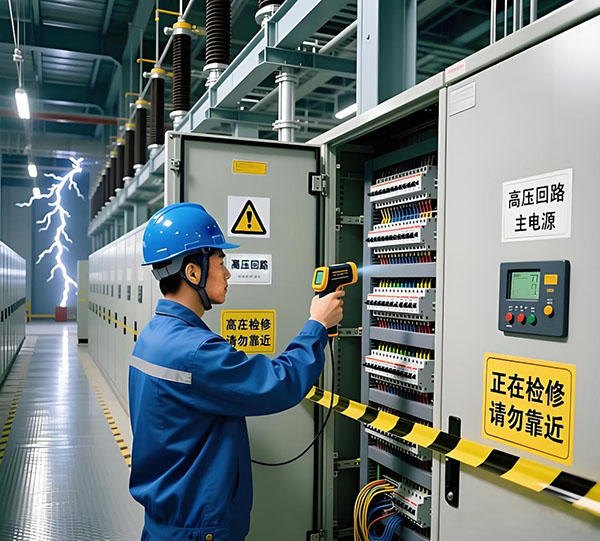
Important Reminder: Always disconnect the power and label the fault before proceeding with any inspection. Safety first! Visual inspection mainly focuses on the following: checking for loose wiring, burn marks, and a burnt smell; verifying broken wires, loose terminals, blown fuses, and burnt contactor contacts; then checking indicator lights, alarm codes on the display screen, and instrument readings; finally, inspecting the motor, cables, switches, frequency converter, and PLC for any obvious abnormalities. In fact, 80% of minor faults can be eliminated at this step.
Step 3: Isolation (Segmentation, Narrowing the Scope)
Divide the entire electrical system into three segments: power supply → control → load, and gradually isolate and troubleshoot. First, disconnect the load, supplying only control power to see if the control section is normal; then disconnect the control and measure if the power supply is normal; further segmentation is possible, such as main circuit, control circuit, signal circuit, and protection circuit, to quickly pinpoint whether the problem lies in the power supply, control, or load.
Step 4: Measurement (Instrument Measurement, Precise Positioning)
Common tools include a multimeter, clamp meter, voltage tester, and megohmmeter. Focus on measuring these four points:
1. Voltage: Measure the voltage of the incoming line, switches, contactor terminals, and control power supply to ensure they are normal.
2. Continuity: Measure the continuity of fuses, contacts, wiring, buttons, limit switches, and emergency stop switches.
3. Insulation: With the power off, measure the insulation of the motor and cables to ground/phase-to-phase.
4. Current: Measure the operating current of the equipment to check for excessive current, phase loss, or overload.
The judgment logic is simple: If there is power but the equipment does not operate, it is likely that a component is damaged (such as a contactor, relay, or sensor); if there is no power, it is mostly due to loose wiring, switches, protection devices, fuses, or terminals.
Step 5: Test (Verify Repair, Prevent Recurrence)
After repair, don't rush to finish; verification is essential: First, restore wiring, run under no-load, then test under load; observe voltage, current, equipment sound, temperature, and any alarms; recheck wiring for tightness, insulation and grounding for good condition, and protection settings for accuracy; finally, record the cause of the fault, the solution, and the replaced components to prevent recurrence.
Typical Case Demonstration (Three-Phase Motor Won't Turn, Easy to Understand)
The most common scenario: A three-phase asynchronous motor (fan/pump, contactor controlled), pressing the start button, the motor doesn't turn, makes no sound, and doesn't trip. Use the five-step method to thoroughly troubleshoot.
Step 1: Ask (Understand the Situation) – The operator says the machine failed this morning, but was normal yesterday, with no abnormal noise, smoke, or tripping; this is the first time the fault has occurred. Preliminary judgment: It's not burnt out or overloaded; most likely, the control circuit has no power or is open.
Step 2: Visual Inspection – After power is cut off and the label is hung, inspect the distribution box. Circuit breakers and fuses appear normal, without burning or loosening. Contactors show no signs of burning or unusual odor. However, the control power indicator light is off, and the emergency stop button pops up normally. This indicates a lack of power in the control circuit.
Step 3: Segmented Isolation – Divide the circuit into three segments: main power, control power, and control circuit. First, test the main power (380V), which is normal. Then test the control power fuse/transformer; a blown fuse is found, pinpointing the control power issue.
Step 4: Precise Location – Use a multimeter to test the main power; the voltage across L1-L2-L3 is approximately 380V, which is normal. Test the control fuse; the incoming line has power, but the outgoing line has no power, confirming the fuse is blown. Then test the contactor coil resistance; it is normal with no short circuit, indicating the blown fuse is due to aging or poor contact.
Step 5: Test (Verify Repair) – Replace the control fuse with one of the same specifications. After power is supplied, the control power indicator light will illuminate. Press the start button; the contactor should engage normally, the motor should start smoothly, the three-phase current should be balanced, and after 5 minutes of operation, there should be no overheating or unusual odor. Tighten the terminals and record the results. The fault is now completely eliminated.
This five-step method requires no complicated techniques. Simply follow the steps on-site to quickly locate electrical faults. Both novice and experienced electricians can apply it directly. If the specific fault scenario is known (e.g., inverter alarm, PLC control fault), the troubleshooting process and measurement points can be adjusted accordingly.
ZDDQ Related power quality solutions: