1.What is Harmonics?
In power systems, the fundamental cause of harmonics is the presence of non-linear loads. When current flows through a load and does not maintain a linear relationship with the applied voltage, a non-sinusoidal current is formed, meaning harmonics are generated in the circuit. Harmonic frequencies are integer multiples of the fundamental frequency. As proven by the French mathematician Fourier’s analysis principle, any repetitive waveform can be decomposed into sinusoidal components containing the fundamental frequency and a series of harmonics that are multiples of the fundamental frequency. Harmonics are sine waves, each with a distinct frequency, amplitude, and phase angle. Harmonics can be classified as even-order and odd-order: the 3rd, 5th, 7th, etc., are odd-order harmonics, while the 2nd, 4th, 6th, 8th, etc., are even-order harmonics. For example, when the fundamental frequency is 50 Hz, the 2nd harmonic is 100 Hz, and the 3rd harmonic is 150 Hz.
Generally speaking, odd-order harmonics cause more and greater harm than even-order harmonics. In a balanced three-phase system, even-order harmonics are eliminated due to symmetry, leaving only odd-order harmonics. For three-phase rectifier loads, the harmonic currents generated are of the order 6n±1, such as the 5th, 7th, 11th, 13th, 17th, 19th, etc. Frequency converters mainly produce the 5th and 7th harmonics.
2.Harmonic Suppression
To solve the harmonic pollution problems caused by power electronic devices and other harmonic sources, there are two basic approaches:
Install harmonic compensation devices to compensate for harmonics, which is applicable to all types of harmonic sources.
Retrofit power electronic devices themselves so that they do not generate harmonics and the power factor can be controlled to 1, which is only applicable to power electronic devices that are the main harmonic sources.
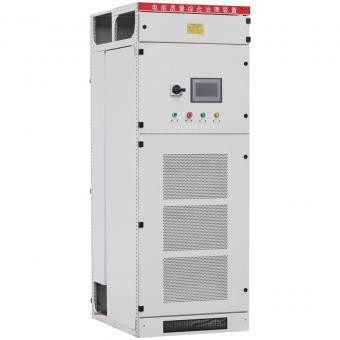
The optimal method for installing harmonic compensation devices is to adopt low-voltage active power filters. This method can compensate both harmonics and reactive power, and the compensation process is unaffected by power grid impedance, avoiding resonance issues. It can dynamically track changing harmonics for real-time compensation, with adaptability and compensation effects far superior to traditional passive filtering devices.
3.Reactive Power Compensation
Reactive power is crucial for the operation of power supply systems and loads. The impedance of network components in power systems is mainly inductive. Therefore, roughly speaking, transmitting active power requires a phase difference between the voltages at the sending and receiving ends, which is feasible within a fairly wide range; while transmitting reactive power requires an amplitude difference between the voltages at both ends, which is only feasible within a very narrow range. Most network components consume reactive power, and most loads also require reactive power. The reactive power needed by network components and loads must be obtained from somewhere in the network. Obviously, it is unreasonable and usually impossible for all this reactive power to be supplied by generators and transmitted over long distances. A reasonable approach is to generate reactive power where it is consumed, which is reactive power compensation.
Anhui Zhongdian is a high-tech enterprise specializing in providing overall solutions for reactive power compensation and harmonic control. It can customize suitable reactive power compensation devices according to the power grid operation conditions and load characteristics of different users, helping users complete reactive power compensation locally and effectively improve power grid quality. Currently, common reactive power compensation methods include low-voltage active power filters, static var generator, and shunt capacitor compensation. Among them, shunt capacitor compensation is the most widely used due to its simple structure, low cost, and convenient maintenance. Reasonable reactive power compensation can effectively reduce power losses in power transmission and transformation links of distribution systems, improve power grid operation efficiency, stabilize voltage levels at the receiving end, enhance power supply quality, and improve the stability of power supply systems.
4.The main functions of reactive power compensation are as follows:
5.Generation of Harmonics and Reactive Power
In industrial and domestic power loads, resistive-inductive loads account for a large proportion. Asynchronous motors, transformers, fluorescent lamps, etc., are typical resistive-inductive loads. The reactive power consumed by asynchronous motors and transformers accounts for a high proportion of the reactive power supplied by power systems. Reactors and overhead lines in power systems also consume some reactive power. Resistive-inductive loads must absorb reactive power to operate normally, which is determined by their inherent properties.
Non-linear devices such as power electronic equipment also consume reactive power, especially various phase-controlled devices. For example, phase-controlled rectifiers, phase-controlled AC power regulation circuits, and cycloconverters have fundamental current lagging behind grid voltage during operation and consume a large amount of reactive power. In addition, these devices also generate a large amount of harmonic currents, and all harmonic sources consume reactive power. The fundamental current of diode rectifier circuits is approximately in phase with the grid voltage, so they basically do not consume fundamental reactive power. However, they also generate a large amount of harmonic currents and thus consume a certain amount of reactive power.
The increasingly widespread application of power electronic devices has made them the largest source of harmonics. Among various power electronic devices, rectifiers account for the largest proportion. Currently, commonly used rectifier circuits almost adopt thyristor phase-controlled rectifier circuits or diode rectifier circuits, with three-phase bridge and single-phase bridge rectifier circuits being the most common. The harmonic pollution and power factor lag caused by rectifier circuits with resistive-inductive loads are well known. Diode rectifier circuits with capacitive filtering on the DC side are also serious harmonic pollution sources. The fundamental component of the input current of such circuits is approximately in phase with the power supply voltage, so the fundamental power factor is close to 1. However, the harmonic components of the input current are very large, causing serious pollution to the power grid and resulting in a low overall power factor.
6.Impacts of Reactive Power and Hazards of Harmonics
(1) Impacts of Reactive Power
(2)Hazards of Harmonics
Categories


NO.25,JINHE RD,HUAIYUAN ECONOMIC DEVELOPMENT ZONE ,BENGBU,ANHUI
Scan to WhatsApp: