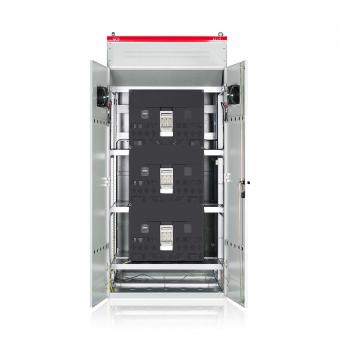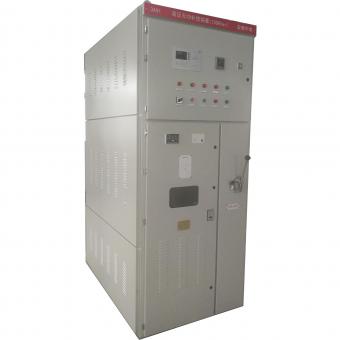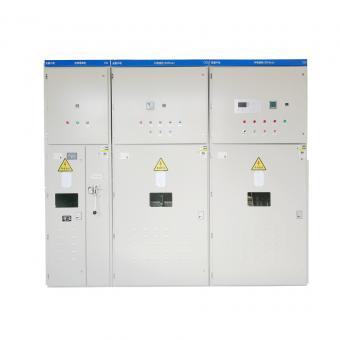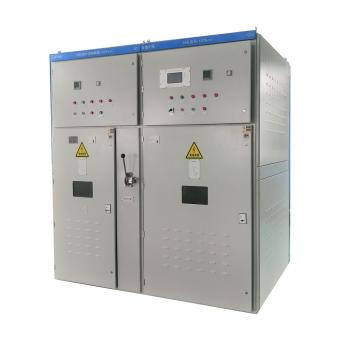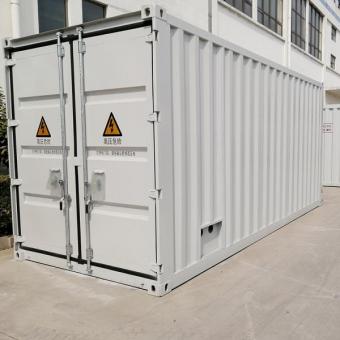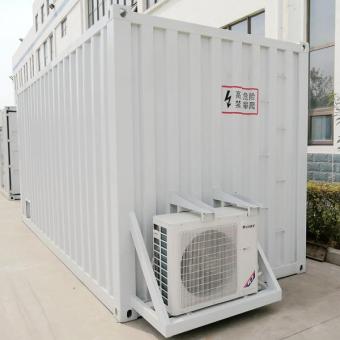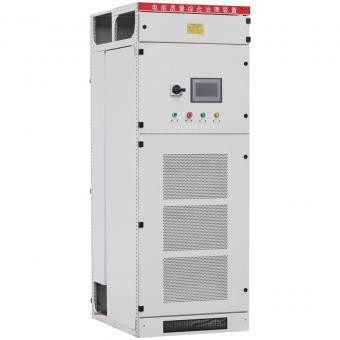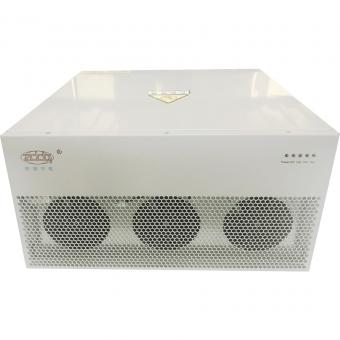
Active Harmonic Filter is a high-power, fast-switching electronic amplifier. Its job is to continuously monitor the electrical system and instantly inject equal but opposite "anti-harmonic" currents to cancel out the distortions. This demanding process generates a significant amount of waste heat, and managing this heat is paramount for several key reasons:
The most heat-sensitive and expensive components in an AHF are the Insulated-Gate Bipolar Transistors (IGBTs) or, in more modern designs, Silicon Carbide (SiC) MOSFETs. These semiconductors act as high-speed switches, creating the precise output waveform.
Heat Generation: They generate heat from two main sources:
Switching Losses: The intense heat generated each time the transistor switches on and off (thousands of times per second).
Conduction Losses: The heat generated when current flows through the transistor while it's on (due to its internal resistance).
The Danger: Semiconductor failure is not gradual. If their maximum junction temperature (Tj max) is exceeded, they can be destroyed in microseconds. This is often a catastrophic failure that can short-circuit and cause extensive, costly damage to the entire unit.The primary role of the cooling system is to keep the semiconductor junctions well within their safe operating temperature.
An AHF is typically installed to protect a facility's electrical system and ensure compliance with power quality standards. If it fails, the entire load—with all its harmonic distortion—is put back on the electrical network, which can lead to:
Tripped Circuit Breakers: Overheating from harmonics can cause nuisance tripping.
Equipment Malfunctions: Sensitive equipment like PLCs, sensors, and drives can behave erratically or fail.
Production Stoppages: In an industrial setting, this is the most costly consequence. An overheated AHF that shuts down can halt an entire production line.
Modern AHFs have internal temperature sensors. If the temperature rises too high, the unit will first derate (reduce its output current) and eventually shut down completely to prevent self-destruction. This thermal shutdown is a safety feature, but it results in production downtime.
Heat is the primary enemy of electronic component longevity. Even if temperatures don't reach catastrophic failure levels, consistent operation at high temperatures accelerates the "aging" process.
Electrolytic Capacitors (in the DC Link): These are particularly vulnerable to heat. For every 10°C increase above their rated temperature, their lifespan is halved. Effective cooling is the single most important factor in ensuring these capacitors last for their intended service life.
PCB Traces and Solder Joints: Cyclical heating and cooling (thermal cycling) causes expansion and contraction, which can lead to cracked solder joints and broken connections over time.
Insulation Materials: Heat degrades the insulation on magnetics (inductors) and wiring, leading to potential short circuits.
A robust cooling system directly translates to a longer Mean Time Between Failures (MTBF) and a higher return on investment.
The electrical characteristics of components like sensors, control chips, and drivers can "drift" with temperature. An overheated AHF may become less accurate in its harmonic compensation. Its ability to precisely measure and cancel harmonics can diminish, leading to a "derating" of performance even if it hasn't yet reached the shutdown point.
Immediate: Thermal Shutdown → Production Halts.
Short-Term: Reduced filtering performance (derating) → Power quality issues persist.
Long-Term: Accelerated aging of components → Premature failure and unplanned capital expenditure for repair or replacement.
Think of the cooling system not as an accessory, but as an essential life-support system. Just as a high-performance sports car requires a sophisticated radiator and cooling system to prevent its engine from melting, an AHF requires a robust thermal management system to dissipate the intense heat generated by its power electronics.
Without effective cooling, even the most advanced and well-designed Active Harmonic Filter is doomed to a short, unreliable, and inefficient life. This is why the choice between air-cooling and liquid-cooling, and a strict regimen of preventive maintenance (like cleaning air filters), is so critical for AHF operation.
Categories


NO.25,JINHE RD,HUAIYUAN ECONOMIC DEVELOPMENT ZONE ,BENGBU,ANHUI
Scan to WhatsApp: